Fundamentals of Integrated Building Design
Performance Based Design: Multifunctional building in Milan
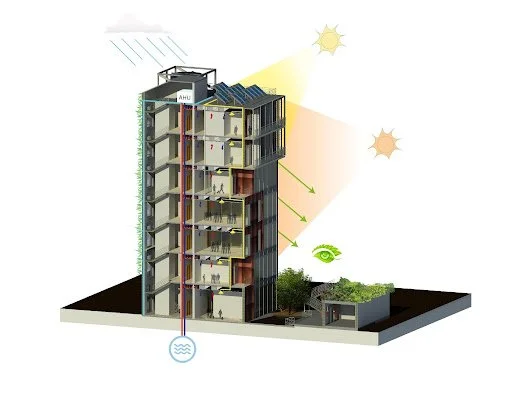
Sustainable Urban Infill Design: Doria Site, Milan
This project investigates how a small vacant site in central Milan (610 m²) can be transformed into a mixed-use building that combines retail, offices, and a hotel, while significantly improving energy performance and environmental quality. The site sits in a dense, highly connected urban area near Loreto and Centrale Station, making it a strong candidate for an urban infill strategy that prioritizes density, accessibility, and reuse of leftover urban space. Doria site was apart of Milan’s participation with C40’s Reinventing Cities global initiative.
The main goal is to design a building that does not operate in isolation, but instead works with its surroundings—using daylight, climate, and natural systems to reduce energy demand and improve comfort.
Design Approach
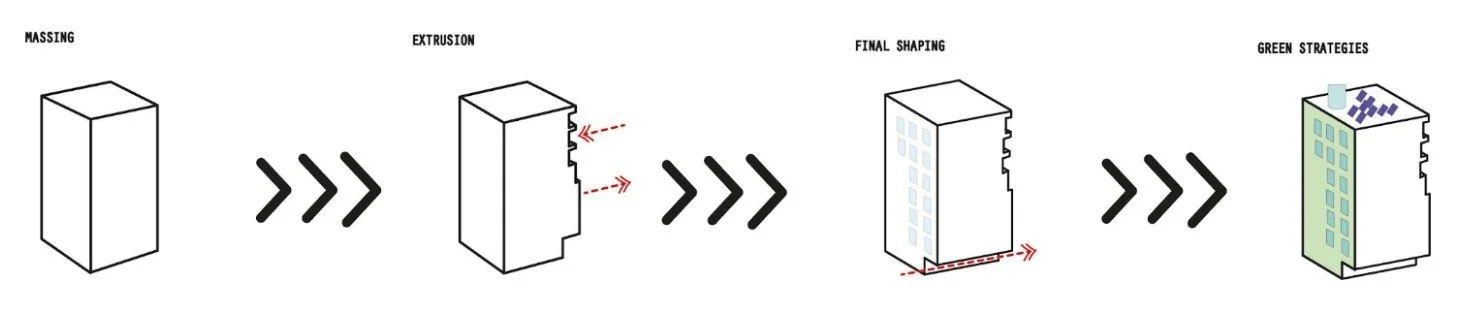
Concept process
The project follows an integrated design method, meaning architecture, structure, and environmental systems are developed together. The building is organized with public and commercial spaces on the ground floor, offices in the middle levels, and hotel rooms on the upper floors. This vertical mix of uses allows the building to stay active throughout the day while responding to different lighting and comfort needs.
The form is shaped by environmental logic: the southern façade is optimized for daylight, while the northern side acts as a more closed buffer zone for services and circulation. The compact massing reduces heat loss and improves overall efficiency.
Façade and Environmental Control
A key part of the design is the façade system, which combines a double-skin façade with integrated shading devices. This system helps control solar gain, especially during Milan’s hot summers, while still allowing natural daylight to enter interior spaces.
The shading strategy reduces glare and overheating in the most exposed areas, particularly on upper floors, while maintaining visual comfort in offices and hotel rooms. This balance between daylight and protection is essential in reducing reliance on artificial lighting and mechanical cooling.
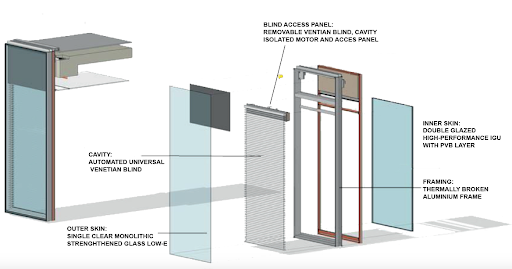
Double skin façade elements by WICONA producer
Energy and Renewable Systems
To reduce operational energy demand, the building incorporates rooftop photovoltaic panels covering approximately 48 m². These panels generate around 12,000 kWh per year, which corresponds to roughly 8% of the building’s total electricity consumption. While this does not make the building fully self-sufficient, it provides a meaningful reduction in grid dependency and emissions.
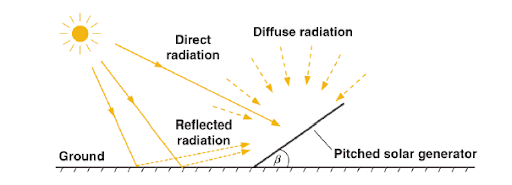
Radiation on titled surfaces (Mertens K., 2014)
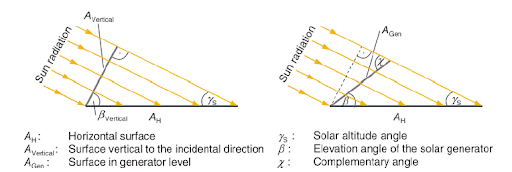
Influence of tilt on direct radiation (Mertens K., 2014)
The building envelope is also optimized with high-performance materials, including low U-value walls and roof assemblies, which help reduce heat transfer and stabilize indoor temperatures throughout the year.
Green Infrastructure and Water Strategy
Vegetation plays an important role in the environmental performance of the project. Green roofs and vertical greenery are integrated across the building to improve air quality, reduce noise pollution, and mitigate the urban heat island effect.
These systems also contribute to carbon reduction, with an estimated ~1,000 kg of CO₂ captured annually across the total planted areas. Beyond environmental performance, the greenery improves the quality of the urban experience, introducing softness and natural elements into a dense city context.
Water management is addressed through a rainwater harvesting system installed on the roof. This system collects approximately 49,000 liters of rainwater per year, which is more than enough to meet the building’s irrigation demand of about 5,700 liters per year. This creates a self-sufficient irrigation loop and reduces dependence on municipal water supply.
Heating and Cooling Strategy
Instead of relying solely on conventional HVAC systems, the building uses an aquifer thermal energy storage (ATES) system. This system takes advantage of stable underground temperatures to store and reuse heat seasonally—cooling the building in summer and supporting heating in winter. This reduces energy consumption and improves long-term thermal stability in a natural way.
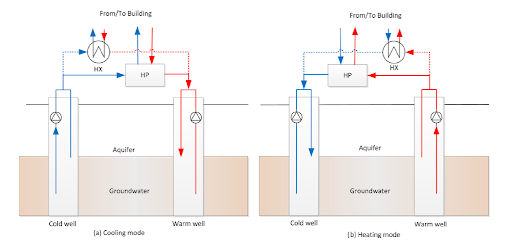
Schematic representations of ATES for cooling mode(a) and heating mode (b)
Performance Results
The combined effect of passive design strategies, façade optimization, renewable energy, and environmental systems leads to a significant reduction in overall energy demand.
Most of these savings come not from one system, but from the interaction of multiple strategies: better daylight use, reduced heat gain, improved insulation, and smarter environmental control.
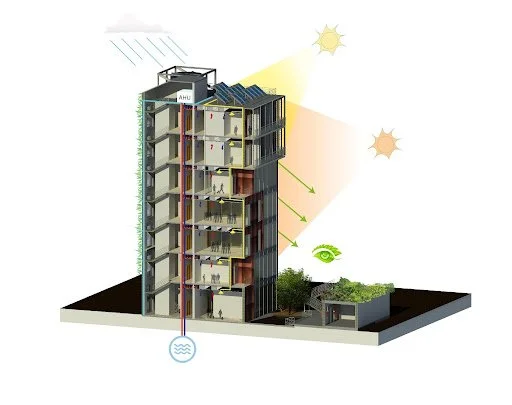
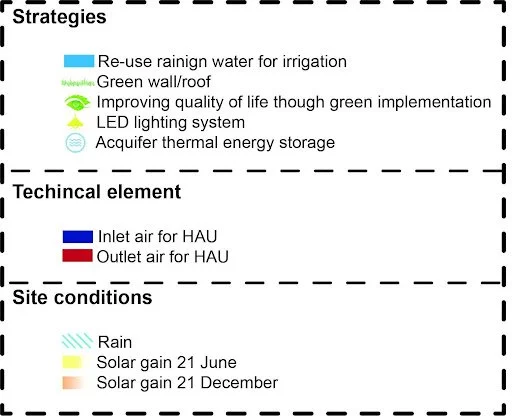
The building’s Energy Use Intensity is reduced from approximately 149 kWh/m²/year to 93 kWh/m²/year, representing a total reduction of about 40%.
Conclusion
This project demonstrates how small urban infill sites can be transformed into high-performance buildings through integrated design thinking. Rather than relying on a single technology, the approach combines architecture, energy systems, greenery, and water management into one coordinated strategy.
The result is a building that is not only more efficient, but also more responsive to its environment—reducing energy use, improving comfort, and contributing positively to the dense urban fabric of Milan.
References
Reinventing cities. Doria site, (2017); www.c40reinventingcities.org/en/sites/doria-1270.html.
Liu Y, Mu YJ, Zhu YG, Ding H, Arens Nan. Which ornamental plant species effectively remove benzene from indoor air Atmospheric Environment (2007); 41:650-654.
Ahmet Besir, Erdem Cuce, Green roofs and façades. Renew Sustain Energy Rev (2018);918: 915–939.
Marchi M, Pulselli RM, Marchettini N, Pulselli FM, Bastianoni S. Carbon dioxide sequestration model of a vertical greenery system. Ecol Model, (2015);306:46–56.
Pérez G, Coma J, Martorell I, Cabeza LF. Vertical greenery systems (VGS) for en-ergy saving in buildings: a review. Renew Sustain Energy Rev (2014);39:139–65.
[6]Safikhani T, Abdullah AM, Ossen DR, Baharvand M. A review of energy char-acteristic of vertical greenery systems. Renew Sustain Energy Rev (2014);40:450–62.
Hunter AM, Williams NSG, Rayner JP, Aye L, Hes D, Livesley SJ. Quantifying the thermal performance of green façades: a critical review. Ecol Eng (2014);63:102–13.
ARPA LOMBARDIA, (2016); www.arpalombardia.it/sites/arpalombardia2013/RSA/Pagine.html
EN DIN 1989-1:2000-12.
Balo F, Şağbanşua L. The selection of the best solar panel for the photovoltaic system design by using AHP. Renew Sustain Energy Rev (2016); 100: 50-53.
Hamilton J. Careers in Solar Power. U.S. Bureau of Labor Statistics, Report 2 (2011).
Jager W. Stimulating the diffusion of photovoltaic systems: a behavioural perspective. Energy Policy (2006); 34: 1935–43.
Nielsen TD, Cruickshank C, Foged S, Thorsen J, Krebs FC. Business, market and intellectual property analysis of polymer solar cells. Solar Energy Materials and Solar Cells (2010); 94(10):1553–1571.
Bruce T. Investigation of Cost and Performance Characteristic of Photovoltaic Panels. Research Dissertation Project (2011); ENG 4111-4112.
Mertens K. Photovoltaics: Fundamentals, Technology, and practice (2018).
Chevalier S, Gauthier J, and Banton O.Evaluation du potentiel géothermique des nappes aquifères avec stockage thermique: revue de littérature et application en deux contextes du Québec, Can. J. Civ. Eng., 24, (1997), 611-620.
AlZahrani A, Dincer I. Performance Assessment of an Aquifer Thermal Energy Storage System for Heating and Cooling Applications. Renew Sustain Energy Rev (2015);10:100-12.
Bridger DW, and Allen DM. Designing Aquifer Thermal Energy Storage Systems, in ASHRAE Journal, (2005).
Alvaro de Gracia, Lidia Navarro, Albert Castell and Luisa F.Cabeza, Energy performance of a ventilated double skin façade with PCM under different climates. Renew Sustain Energy Rev (2015);91:37-42.
Marinoski D, Guths S, Lamberts R. Development of a calorimeter for determination of solar factor of architectural and fenestrations. Build Environ (2012);232-242
Johnson, R., Sullivan, R., Selkowitz, S., Nozaki, S., Conner, C., Arasteh,D., 1984. Glazing energy performance and design optimization with daylighting. Energy and Buildings 6 (4); 305–317.
Nielsen M, Svendsen S, Jensen L. Quantifying the potential of automated dynamic solar shading in office buildings through integrated simulations of energy and daylight, ScienceDirect (2011); 757-768.
Lee ES, DiBartolomeo DL, Selkowitz S. Thermal and daylighting performance of an automated venetian blind and lighting system in a full-scale private office. Energy and Buildings (1998); 29 (1), 47–63.
Nielsen TR. Simple tool to evaluate energy demand and indoor environment in the early stages of building design. Solar Energy (2015);78 (1), 73–83.
Nezamdoost A, Wymelenberg K. A daylighting field study using human feedback and simulations to test and improve recently adopted annual daylight performance metrics. Journal of building performance simulation (2017); 10:5-6, 471-483.
